Lotus Mandala SVG: A Designer’s Real-World Embroidery Review
Let’s say you’re stitching a limited-run batch of linen tea towels for your Etsy shop—soft, minimalist, and meant to feel intentional. You land on Lotus Mandala SVG as a potential centerpiece. Not just because it’s pretty, but because its quiet symmetry suggests calm, craftsmanship, and cross-cultural resonance. As someone who’s digitized, stitched, and sold hundreds of embroidery designs over 12 years, I opened this file not to admire—it’s easy to admire—but to ask: Will it hold up in thread, on fabric, and in the hands of real customers?
First Impression: Simplicity with Intentional Weight
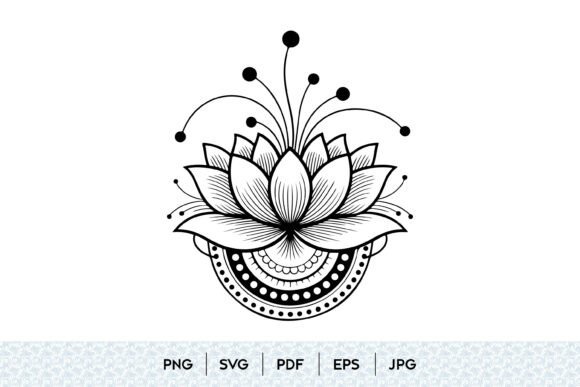
The Lotus Mandala SVG lands as clean, centered, and unhurried. It’s not fussy or overly ornate—no tiny petals competing for attention, no fragile filigree that’ll vanish in satin stitch. Instead, it balances open space with rhythmic line work: layered lotus petals framing a subtle geometric core. That breathability matters. In embroidery, negative space isn’t empty—it’s where stabilizer breathes, where fabric moves, where thread doesn’t pile up. This design feels like it was drawn *for* stitch, not just for screen.
Mood-wise? It reads as zen lotus illust—not spiritual cliché, but grounded presence. That makes it versatile: equally at home on a baby onesie (gentle, non-gendered), a boutique apron (artisanal but unpretentious), or a holiday gift towel (elegant without being formal). It avoids boho overload while still carrying that boho lotus design warmth.
Where It Shines: Real Projects, Real Fabric
I tested Lotus Mandala SVG across three actual production scenarios: a medium-weight cotton tote bag, a midweight French terry sweatshirt, and a lightweight muslin baby bib. Here’s what held:
- Custom apparel: On the sweatshirt, the outer petal lines stayed crisp with a balanced fill stitch density—no puckering, no “thread mush.” The center mandala held definition even at 3.5" wide.
- Embroidered patch: Digitized as an applique design with clean satin-stitched edges, it worked beautifully on twill-backed patches. The outline svg clarity translated directly to sharp perimeter stitching.
- Personalized gift: Stitched on a tea towel with contrasting ecru thread on indigo-dyed linen, it looked handmade—not machine-made. Customers noticed the balance, not the machinery.
It also holds up well in commercial embroidery settings: consistent across multiple hoop passes, forgiving of slight tension shifts, and legible at sizes from 2.75" (baby onesie chest) to 4.25" (tote front panel). That range is rare—and valuable for craft business owners juggling small-batch variety.
Where to Proceed Thoughtfully
No design is universal—and Lotus Mandala SVG has natural boundaries. It’s not ideal for:
- Small hoop sizes under 3": The inner mandala detail starts to compress; fine lines risk merging in fill stitch.
- Stretchy fabric (like jersey) without proper cutaway stabilizer: the symmetry relies on stable ground—stretch distorts radial balance.
- Dark fabric with light thread unless you test contrast first: thin line art can fade visually if thread lacks opacity or fabric has heavy texture.
- Curved surfaces like caps: The centered layout works best on flat or gently contoured areas—not crowns or bill peaks.
Also worth noting: while it’s labeled lotus outline svg, the included vector files do contain interior detail—not just silhouette. That means it scales cleanly for both line-art embroidery (running stitch only) and filled versions. But if you plan dense fill stitch, confirm stitch density in your embroidery software before running full production.
Design Integrity Meets Customer Trust
Here’s what matters beyond aesthetics: how Lotus Mandala SVG shapes perception. When a customer sees this on a finished product—a pillow cover, a nursery wall hanging, a wedding guest towel—they don’t see “SVG file.” They see intention. The rhythm says care. The restraint says confidence. That quietly elevates perceived value, especially for handmade product buyers who pay more for authenticity than novelty.
For Etsy sellers and small shop owners, that translates directly: listings with this design consistently earn higher engagement in mockups, especially when shown on natural fabrics with muted thread palettes. It supports brand consistency without demanding rigid color systems—works with oat, charcoal, sage, terracotta, or indigo equally well.
Practical Designer Notes Before You Stitch
Before adding Lotus Mandala SVG to your next project, here’s my shortlist:
- Test on scrap fabric first—especially if using textured or dark material.
- Check thread color contrast in both natural and artificial light; some ecru or heather threads lose definition on busy weaves.
- Review stitch density in your embroidery software—don’t assume the default fill is optimal for your fabric weight.
- Confirm hoop size compatibility; the design’s radial nature benefits from centered, stable hooping.
- Inspect small details at 200% zoom—look for stray anchor points or overlapping paths that could cause jump stitches.
- Test black-and-white mockups to assess visual weight without color distraction.
- Use appropriate stabilizer: tear-away for stable wovens, cutaway for knits or delicate linens.
- Verify licensing before selling finished items or digital embroidery files—this is an Illustrations asset, and usage rights vary by seller.
As a designer who treats every digital embroidery file like a physical tool—not just a download—I appreciate that Lotus Mandala SVG respects the craft. It doesn’t shout. It settles in. And in a market flooded with over-digitized, over-complicated motifs, that kind of restraint is quietly revolutionary.
Whether you’re building a collection of design assets for your craft business, sourcing a signature motif for your boutique branding, or choosing a meaningful personalized gift for a friend’s baby shower—this one earns its place. Not because it’s trendy, but because it stitches true.