★★★★☆4.5(86 reviews)
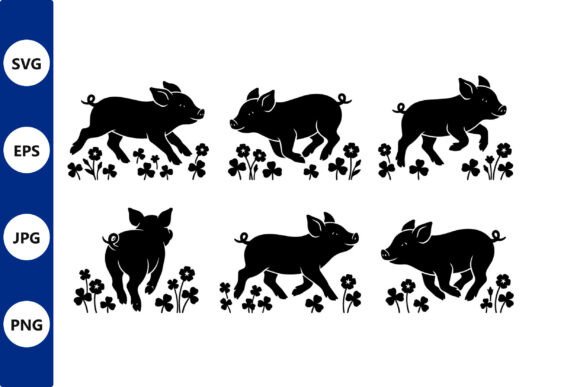
Pigs in Clover Silhouette Art
A Playful, Farm-Charm Pattern That Stitches Clean—But Only If You Respect Its Rhythm
I pulled up Pigs in Clover Silhouette Art last week while prepping a custom order: a set of linen tea towels for a local farm-to-table café. Their branding leans rustic but refined—no cartoonish clutter, no overworked details. Just warmth, wit, and quiet intention. The moment I zoomed in, I knew this wasn’t just another “cute pig” graphic. It’s a repeated silhouette pattern—black pigs meandering through clover, all clean vector lines, no gradients or shadows. No fuss. Just shape, repetition, and gentle motion. That simplicity is its strength—and its quiet demand.First Impressions: Charm Without Clutter
What hits you first isn’t cuteness—it’s clarity. Each pig is a confident, single-contour silhouette: rounded bellies, perky ears, slightly tilted snouts that suggest curiosity, not caricature. The clover is minimal—three soft lobes, spaced generously. Because it’s built as a repeat, the rhythm feels organic, not mechanical. It breathes. That matters immensely when translating to stitch. Unlike dense illustrative graphics, Pigs in Clover Silhouette Art doesn’t ask your machine to fight itself. It asks you to trust negative space—and your customer’s eye.Where It Shines (and Where It Pauses)
On the tote? Perfect. The repeat scaled cleanly across the front panel. With black thread on natural canvas, the contrast popped without harshness. Customers at the craft fair paused, smiled, and said, “That’s *us*”—which tells you everything about brand resonance. As a tote bag design, it reads instantly, even from three feet away. The onesie was trickier—not because of the design, but because of fabric behavior. Modal blends shift under tension. I used tear-away + light cutaway stabilizer, reduced stitch density slightly in the clover repeats, and avoided stitching directly over seams. Result? Soft, flexible, wash-safe. A win for baby embroidery, provided you treat the substrate with care. The patch surprised me. At 4 inches, the pig silhouettes retained legibility, and the open clover spacing prevented fill-stitch bleeding. It looked handmade—not digitized-to-death. Ideal for boutique merchandise or embroidered patch collections where texture and authenticity matter more than pixel-perfect replication. Where it hesitated: on dark, stretchy French terry (for a youth sweatshirt). The black-on-black made detail vanish unless I switched to cream thread—but then the farmyard charm softened. Also, on curved cap fronts, the repeat’s flow broke visually near the crown seam. Not a flaw—just a reminder that Pigs in Clover Silhouette Art thrives on flat, stable surfaces. Save it for sweatshirt embroidery on relaxed-fit backs or side panels, not high-tension curves.Design Integrity Meets Real-World Wear
This isn’t a design that shouts. It whispers “thoughtful,” “handmade,” “intentional.” That elevates perceived value—especially for personalized gift buyers or small shop product shoppers scrolling Etsy. I’ve seen customers skip generic florals for this exact tone: pastoral but modern, nostalgic but not twee. Visually, it supports brand consistency beautifully. Pair it with neutral thread palettes—oat, slate, moss—and it becomes part of a cohesive craft business aesthetic. Use it in a printable mockup for your Etsy listing, and it reads as lifestyle-ready, not clip-art-generic.Smart Embroidery Moves Before You Stitch
Before committing to your next embroidery project, do these six things:- Test on scrap fabric *identical* to your final substrate—even if it’s just a swatch. Fabric texture changes how negative space reads.
- Check thread color contrast on both light and dark backgrounds. Black-on-cream sings. Black-on-charcoal fades unless you adjust density or add underlay.
- Review stitch density in the clover repeats. Tight fills can stiffen lightweight fabrics; looser fills may fray after washing.
- Confirm hoop size compatibility. This pattern scales well—but tiny hoops (under 3 inches) will crop the repeat awkwardly. Aim for 4–5 inches minimum for full motif integrity.
- Inspect small details at actual stitch size. Those pig ears? They’re charming at 100%, but vanish if shrunk below 2.5 inches without re-digitizing.
- Verify licensing before selling finished items. As a digital embroidery file in the Illustrations category, usage rights determine whether it fits your commercial embroidery model—or stays personal-only.
Final Thought: It’s Not Just a Graphic—It’s a Mood Anchor
Pigs in Clover Silhouette Art works because it doesn’t try to do everything. It holds one note—playful pastoral—and holds it cleanly. That makes it unusually versatile for custom apparel, holiday embroidery (think Easter baskets or spring baby showers), nursery decor, kitchen linens, and even wedding favors for farm-style celebrations. It won’t dazzle with complexity. But it will earn repeat orders. It will make customers say, “I *know* that feeling.” And for an embroidery designer, a small business owner, or an Etsy seller, that kind of quiet resonance—the kind that stitches well, sells honestly, and represents your craft without shouting—is worth more than any trend.
⬇️ Download Free
Free download · No sign-up required
🔗 You Might Also Like
Illustrations
As a graphic designer who’s built brand identities for boutique skincare lines, ...
Illustrations
As a designer who’s stitched over 300 client projects—from nursery pillows to bo...
Illustrations
First Impressions Matter More Than You Think When I opened this Vintage Camera F...
Illustrations
When I first opened the 15 Sunflower Pot Silhouette SVG Bundle , I immediately s...
Illustrations
First Impressions: A Whimsical Blend of Freedom and Light When I unzipped the Bi...
